Comminges in the Modern Era
The Modern Era in Comminges
In France, this is a period of major political, cultural, religious, and economic changes that marks the transition between the Middle Ages and the contemporary era. It spans from the 15th to the 18th century, more precisely until the French Revolution. Comminges in the modern era does not escape these major upheavals.
15th century, the reign of Francis I (1515-1547), the Renaissance era of great patrons of the arts, notably the Medicis who supported major artists such as Sandro Botticelli, Leonardo da Vinci, Michelangelo…
It was also Gutenberg in 1450 who developed printing in France, the century of great discoveries with Christopher Columbus in 1492, Vasco da Gama in 1498, Magellan in 1520… and the emergence of international trade.
It was also the beginning of the construction of the Loire châteaux (Chambord…)
It was also the major period of the Wars of Religion in the 16th century, the conflict between Catholics and Protestants (called Huguenots, who were numerous in the southwest), including the St. Bartholomew’s Day Massacre that took place in Paris in 1572, which culminated in the killing of several thousand Protestants by Catholics.
17th century, reign of Louis XIV (1643-1715) who established absolute monarchy, royal power was centralized, the construction of the Palace of Versailles, development of culture that leads us toward the Age of Enlightenment in the 18th century, a movement that criticized absolute monarchy and defended reason, liberty, and equality. It was the crisis of the old regime taking shape with important philosophers such as Voltaire, Rousseau, or Montesquieu… These ideas contributed to challenging the Ancien Régime, which would ultimately lead to the French Revolution.
In Comminges several monuments were built or profoundly transformed in the modern era, we cannot escape the influence of the Renaissance. This period corresponds to the time of bishops and local nobility, as well as adaptations of medieval towns.
In Comminges, we adapted to the movement and built
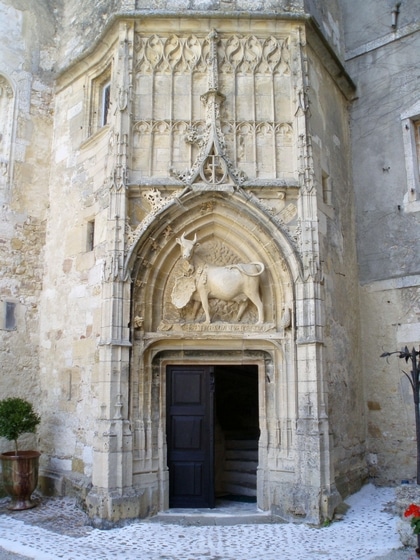
the episcopal palace of Alan
It was the summer residence of the bishops of Comminges.
At the end of the 15th century, Bishop Jean de Foix de Grailly transformed the residence into a palace decorated with frescoes and enriched with flamboyant architectural elements.
The most famous element is the spiral staircase tower with a sculpted tympanum depicting a cow (emblem of the Foix family).
This palace illustrates the aristocratic and episcopal residence of the Renaissance in Comminges.
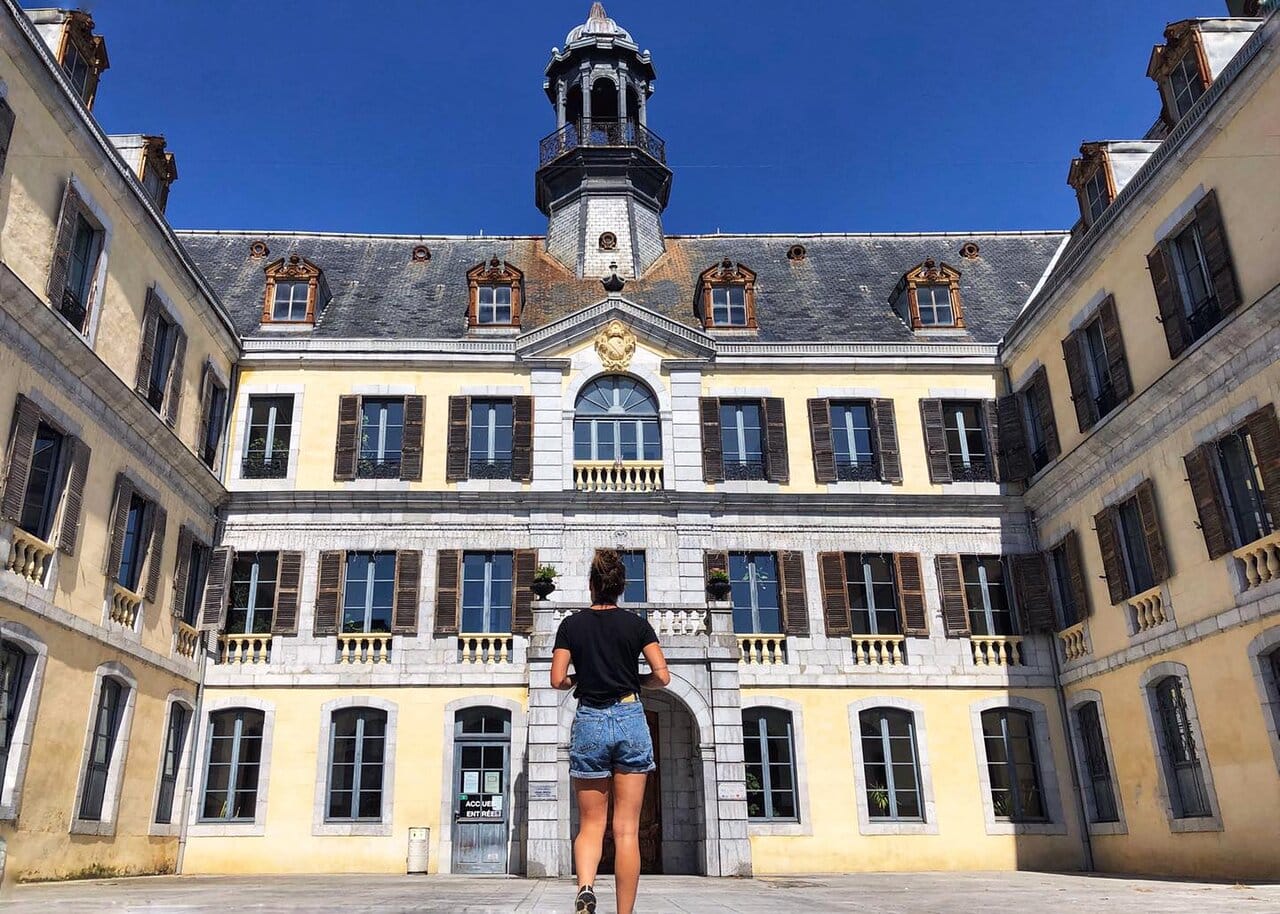
The Hôtel de Lassus
Located in the heart of Montréjeau, the Hôtel De Lassus was built in the mid-18th century (begun in 1760) by Baron de Lassus, then heavily modified a century later with the addition of a floor and high roofs.
The Hôtel De Lassus is a private mansion; there were others at this time that were built at different locations in Montréjeau.
In the mid-18th century, the Lassus family was ennobled by the King of France thanks to the transport of marble from Saint-Béat, which can be found in certain Parisian buildings. At that time, the mansion had only one floor and its roof was covered only with tiles. Generations of the De Lassus family lived in this mansion. And in the 19th century, they built the Château de Valmirande.
Renovations of Medieval Buildings
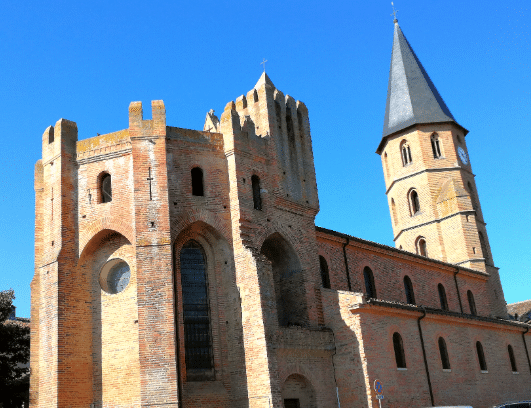
The Middle Ages left numerous buildings, particularly religious ones, that had to be modified to adapt to the demographic growth of Comminges, to modernize the sites, and to address the wear of time. These changes were accentuated in the 19th and 20th centuries.
This concerns the ramparts of Saint-Bertrand-de-Comminges, which date from Antiquity and the Middle Ages, but the gates and entrances were redesigned in the 16th and 17th centuries to facilitate circulation. Modern houses opened into the wall, modifying its defensive appearance. This shows the evolution of fortified towns when military functions became less important.
Churches such as those in L’Isle-en-Dodon, Boulogne-sur-Gesse, Montréjeau, Saint-Gaudens, Aurignac, and others in small villages throughout Comminges saw their structure modified; they were enriched with religious objects and stained glass windows…
The county towns lost the use of their fortifications; the walls would soon be used by the population to build their houses and shops. The counts’ castles were abandoned and in ruins; their stones, bricks, and other materials were used by the population to build their dwellings.